

 Automation
  Integrations
  Feedback Management
  Session Replay
  Feedback Widget
About Boast
Since 2011, Boast has helped more than 2,000 businesses across North America tap into over $675 million in innovation capital. The platform integrates financial, payroll, and engineering data into one system that maximizes R&D tax credits, combining AI with specialized tax expertise to help businesses capture every eligible dollar while keeping audit-proof documentation from day one.
The Business Challenge
At Boast, Blake Nelson wears three hats: Product, Support, and QA. Before Userback, feedback came in through Google Forms, and keeping it organized fell entirely on him.
The feedback loop was long and there was too much manual work involved in prioritization of feature requests and bugs. As the only product, support, and QA for the company, I was spending too much of my time staying organized with these items.
The cost wasn’t just Blake’s time. Without a system to track what happened to a submission after it came in, users had no way to know whether anyone had seen it. Users felt unheard and the key pain points in the application were not being addressed.
Blake needed something that wouldn’t demand a big setup lift but could grow alongside a lean team.
“Keeping up with incoming feedback and responding to requests is nearly a full time job. As a small team we needed something lightweight that could grow with us. Userback offered the perfect balance.”
The Userback Solution
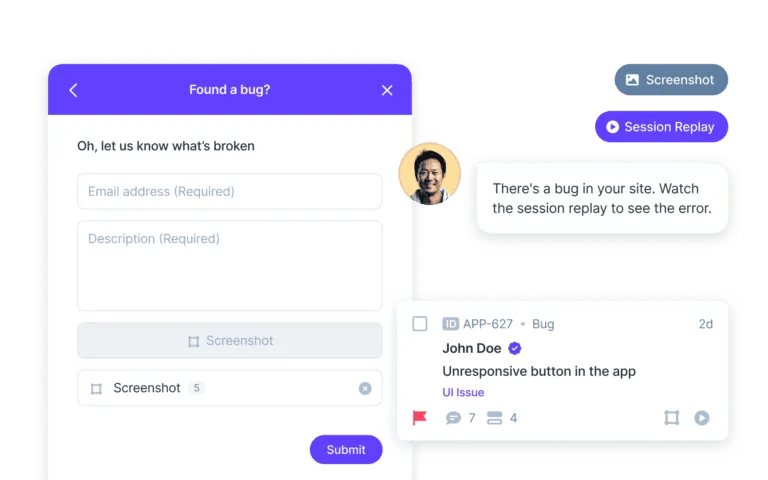
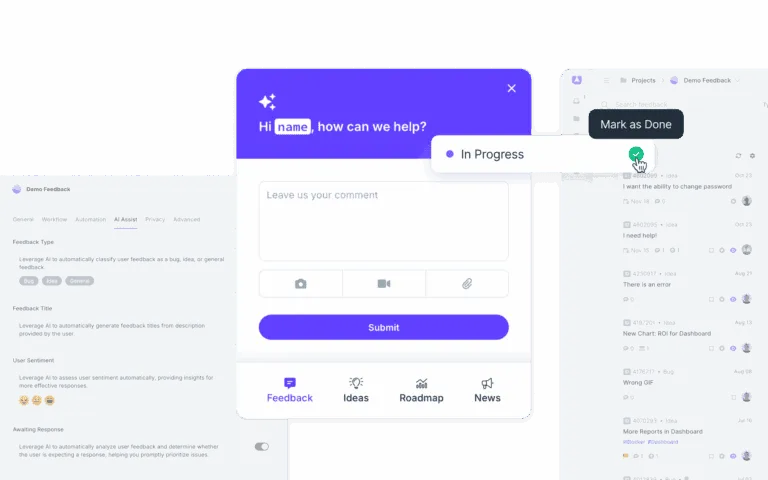
Boast didn’t try to implement everything at once. Blake started with basic bug submission through the Userback widget on Boast’s production web app, open to both internal and external users. From there, the setup grew with a Jira integration, custom statuses, automated reply and resolution messaging, plus a dashboard that Blake now uses to prioritize incoming feedback in real time.
We started with a basic bug submission. Then added the connection to Jira. Now we have custom statuses, automated messaging, and use the dashboard to prioritize live. It’s cut out a lot of that manual work and given us one place to look.
Blake still triages and prioritizes everything himself, passing issues to engineering or fixing them directly. What changed is what happens after a user submits feedback. Automated updates now keep them in the loop as their submission moves through the process.
Previously, users thought their feedback was going into a black hole. Now they get clear updates when things progress.
Boast’s Results With Userback

Faster bug resolution
Bugs and feature requests are now being managed 75% faster.

Actionable feedback
Critical bugs are now being actioned 50% faster with rich context.

Streamlined team
Product, support, and QA are now being streamlined with a single tool.
The time savings show up directly in Blake’s workload. A 75% reduction in time spent organizing bugs and feature requests, and a 50% faster response to critical bugs. Feedback volume runs at 1 to 3 submissions a day on a normal week, spiking significantly after a new feature launch, all still managed by one person.
The bigger shift is on the user side. Boast now reports greatly improved transparency and a stronger sense among users that their feedback is actually heard.
Previously, our users often needed to follow-up and try to figure out where things stood. Now they know that when they submit something, we’re on it!
Blake’s advice to teams considering Userback mirrors how Boast implemented it.
“Start basic and address your biggest problem first. You will quickly adapt and start adding more and more of the features over time.”
And while it’s not a metric that Blake reports to his team, one important metric he attributes to his switch to Userback… his average heart rate is now down by 4 bpm!