
Product-Led Growth Strategy: How to Implement It, and the Blind Spot It Creates
Value first, self-serve onboarding, fast time to value, growth loops — and the intelligence channel you lose when the salesperson goes.


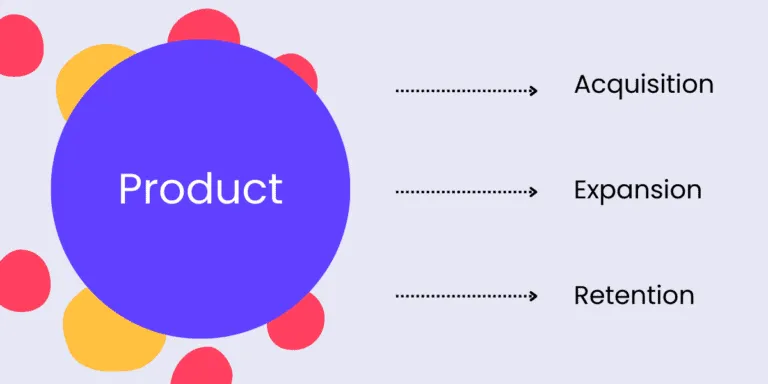
A product-led growth strategy makes the product itself the engine of acquisition, conversion and expansion: people reach value before they talk to anyone, and usage does the qualifying. Implementing it is six steps. The part most guides omit is what you lose when the sales conversation disappears.
Key Takeaways
- PLG moves qualification out of a conversation and into the product experience
- Design the free tier around the activation action, not by subtracting from paid
- Time to value gates everything downstream; net revenue retention decides the economics
- Removing the salesperson removes your main source of qualitative insight — replace it deliberately
What is a product-led growth strategy?
A product-led growth strategy is a go-to-market strategy in which the product itself drives customer acquisition, conversion and expansion. People sign up, use the product and reach value on their own, and the sales team enters late or not at all rather than standing between the user and the software.
Product led growth is often described as a marketing choice. It is closer to an operating decision that reaches into product development and customer success as much as into marketing: you are moving the point at which a stranger becomes a customer out of a conversation and into the product experience. Everything that used to happen in a demo — qualification, objection handling, teaching — now has to happen through the interface, or it does not happen at all.
The four principles behind product-led growth
Strip away the vocabulary and the basics of product-led growth come down to four things, all of which have to be true at once for the product-led growth model to work.
Value before payment. A free trial or a free tier lets someone use the product and get a real result before spending anything. Not a tour, not a sandbox — a result they would miss if it were taken away.
Self-service onboarding. Signup to first value happens without a human. Every step that requires an email to support is a place where a percentage of users leave and are never counted.
Fast time to value. The onboarding flow is measured in minutes, not sessions. In a sales-led motion an account executive holds a hesitant buyer’s attention for weeks; in PLG you have one sitting.
Growth loops built into use. Using the product exposes it to other people — shared links, invited collaborators, exported work carrying a mark. This is what makes customer acquisition cost fall as usage rises, and it is the difference between a self-serve product and a genuinely product-led one.
Product-led growth and sales-led growth, side by side
| Dimension | Product-led | Sales-led |
|---|---|---|
| Who does the qualifying | The product, through usage signals | The sales team, through discovery calls |
| First contact with a human | After the user is already active, if at all | Before the product is ever seen |
| What the buyer evaluates | Their own experience of the product | A demo and a set of claims |
| Cost of acquiring one customer | Falls as usage and referrals compound | Roughly fixed per deal, and rises with deal size |
| Realistic deal size | Small to mid, expanding over time | Large from the start |
| Where the friction lives | Onboarding, activation, upgrade prompts | Pipeline, negotiation, procurement |
| How you learn why someone left | Only from product data and feedback you collect | The account executive tells you |
Most companies that describe themselves as product-led are actually hybrid, running a self-serve motion at the bottom and a sales-led growth model on enterprise accounts above a threshold. That is a legitimate design rather than a failure to commit. The last row is the one nobody plans for, and it is the subject of the section below.
How to implement product-led growth
Six steps, in order. Most product-led growth strategies fail on the first two, which are decisions rather than engineering; the last two only work once the first four hold.
- Decide what “value” means, precisely
Name the single action that means a new user has understood the product — the first report published, the first teammate invited, the first integration connected. Everything else in a product-led growth strategy is built to get people to that action, so an imprecise definition here makes every later measurement soft. Pick something a user does, not something they see.
- Design the free tier around that action, not around limits
The common mistake is to design free by subtraction: take the paid product and remove things. That produces a free tier that demonstrates frustration. Design it so the activation action is fully available and the limits appear at the point where a user has clearly outgrown free — more seats, more volume, more history. Free should be genuinely useful and obviously finite.
- Remove every human dependency before first value
Walk the path from signup to the activation action and count the places a user would have to ask someone. Manual provisioning, a required onboarding call, a setting only support can change: each is a leak. This step is unglamorous and usually produces the largest single improvement in a PLG funnel.
- Instrument the funnel, then instrument the feedback
Product analytics tells you where people stop. On its own it will not tell you why, and in a product-led model there is no account executive who can. Put a way to capture feedback at the points where product usage says people struggle, so the drop-off and the explanation arrive together.
- Add the growth loop
Find the natural reason a user would put the product in front of someone else — sharing output, inviting a collaborator, a public artefact. A loop that fits how people already work will drive growth quietly for years; a referral scheme bolted on afterwards rarely does.
- Layer sales on top, not in front
When accounts cross a usage threshold, a human conversation adds real value. The rule that keeps the model intact is direction: sales follows product signals rather than gating access to the product. This is the hybrid motion most successful PLG companies actually run.
Product-led growth metrics that matter
| Metric | What it measures | Why it earns its place |
|---|---|---|
| Time to value | How long from signup to the activation action | The single best predictor of whether PLG works for you |
| Activation rate | Share of signups reaching that action | Everything upstream is wasted if this is low |
| Free-to-paid conversion | Share of free users who ever pay | Judge over a cohort's lifetime, not per month |
| Product-qualified leads | Free users whose usage says they are ready | The signal that replaces the discovery call |
| Net revenue retention | Expansion minus churn within existing accounts | Where product-led economics are actually won |
| Customer acquisition cost | Blended cost to acquire one paying customer | Should fall over time; if it is flat, the growth loop is not working |
| Viral coefficient | New users generated per existing user | Above 1 is rare and usually miscounted |
Two of these deserve priority over the rest: time to value, because it gates everything downstream, and net revenue retention, because a product-led business with weak expansion is a treadmill. How to choose and set targets is covered in the product management KPIs guide.
Product-led growth examples, and what they share
| Company | What a free user actually gets | The loop that drives acquisition |
|---|---|---|
| Slack | Full messaging for a team, with older history hidden | Work happens in shared channels, so every invited colleague becomes a user |
| Figma | A working design file that others can open in a browser | The product for free to anyone you send a link to; viewers become editors |
| Calendly | A real booking link on the free plan | Every meeting invitation puts the product in front of the other party |
| Dropbox | Usable storage, expandable by referral | Shared folders require the recipient to have an account |
| Canva | Genuinely finished designs, exportable | Output is shared publicly, and templates are collaborative |
These product-led growth companies span design, storage, scheduling and messaging, so the category is not what they have in common. The shared trait is in the third column: the product drives acquisition because ordinary use exposes it to someone new. A free tier without that loop is a discount, not a product-led approach — which is why copying the pricing page of a successful product-led growth strategy so rarely reproduces the result.
Benefits of product-led growth, and who it does not suit
The benefits of product-led growth are real and worth stating plainly, because they are what makes the operational cost of becoming a product-led company worth paying.
Acquisition gets cheaper as you grow. In traditional sales-led growth, each new customer costs roughly what the last one did. A working growth engine inverts that: existing usage produces organic growth, so leads arrive without a proportional increase in spend.
Leads arrive pre-qualified. A product-qualified lead has already used the product and found value. Growth teams working these leads convert far better than teams working cold ones, because the evaluation happened before the conversation.
Feedback about the value of the product is continuous. Product-led businesses see what every user does, every day, instead of what a handful said in a quarterly call.
Revenue growth compounds inside the base. Expansion inside existing accounts becomes the main engine of business growth, which is more durable than chasing new logos.
Product managers get a shorter feedback path. The distance between a decision and evidence about whether it worked is days rather than a sales cycle.
It does not suit everything, and adopting a product-led growth strategy where it does not fit is an expensive mistake. Products that need configuration before they do anything, that are bought by someone who will never use them, that carry regulatory onboarding, or whose value only appears after months of data, all fight the model. So do businesses whose economics require large contracts from day one — sustainable growth there still runs through a sales team, and the honest answer is a hybrid where self-serve feeds a pipeline rather than replacing it. The question to prioritize is not whether PLG is better as a business strategy, but whether a stranger can reach real value in your product alone, in one sitting.
The blind spot nobody plans for: nobody is talking to your users
Every guide to product-led growth celebrates removing the salesperson from the funnel. Almost none of them mentions what that costs, and it is the thing that most often stalls a PLG transition in year two.
In a sales-led company, someone speaks to every prospect. That account executive is an intelligence channel: they hear the objection, the confusion, the missing integration, the competitor who came up. It is unstructured and biased, but it exists, and it is why sales-led product teams are rarely short of qualitative input.
Remove that role and the channel goes with it. A product-led company can see, in perfect detail, that 43% of signups abandon at the workspace-setup step — and has no idea why. Product analytics is excellent at where and structurally silent on why. The users who could tell you are precisely the ones who left, quietly, without ever speaking to anyone.
So the honest version of the fourth principle is this: a product-led growth strategy has to replace the salesperson as a listening post, not just as a seller. That means feedback capture built into the product at the points where the funnel leaks, session recordings for the paths that fail, and a way for a free user — who has no account manager and no incentive to file a support ticket — to tell you something in two clicks. Companies that skip this optimise their onboarding flow by guessing, which is expensive and slow.
Keeping a listening post inside the product
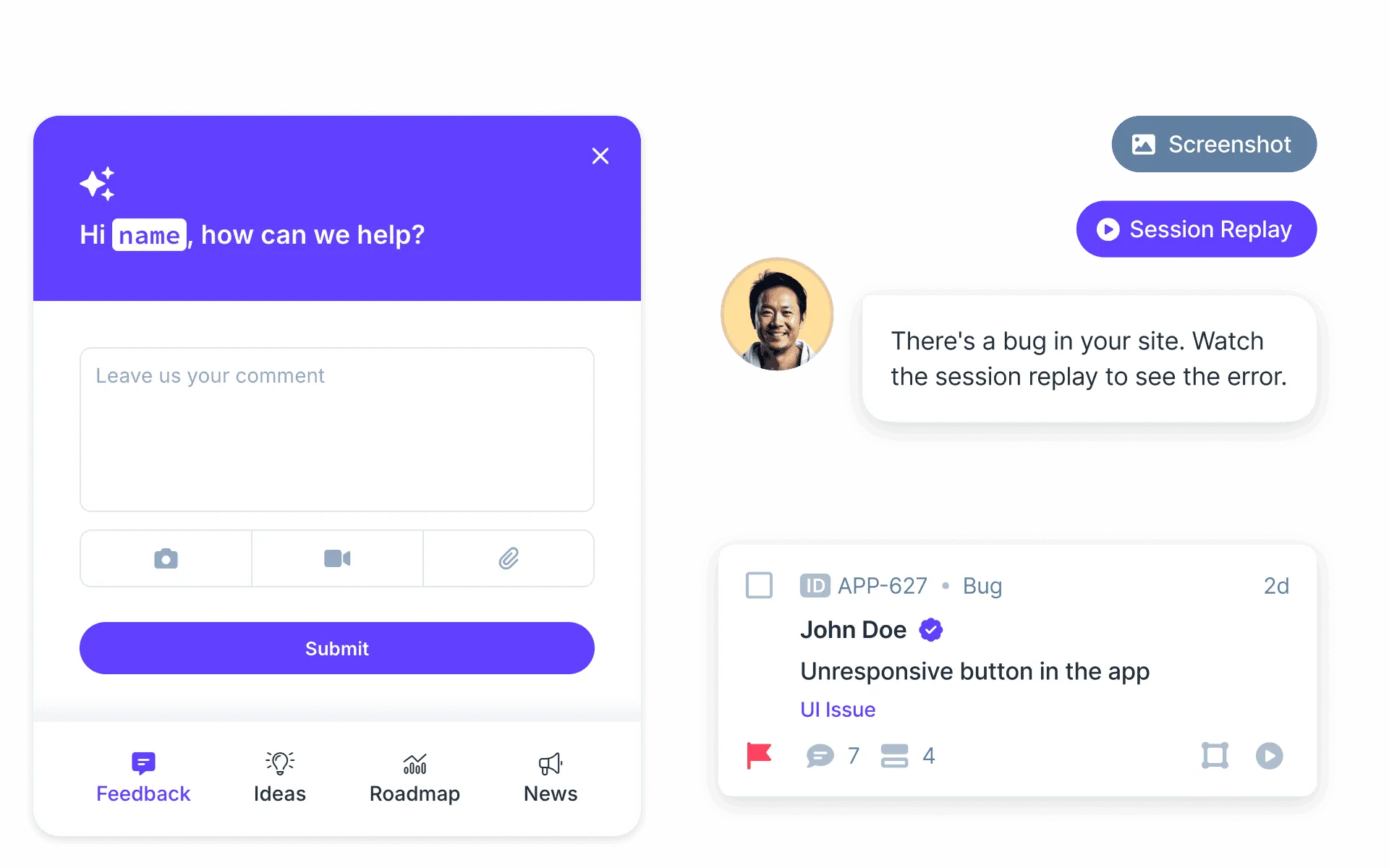
This is the gap Userback sits in. It gives a product-led company the channel the sales team used to provide, without putting a human back in front of the product.
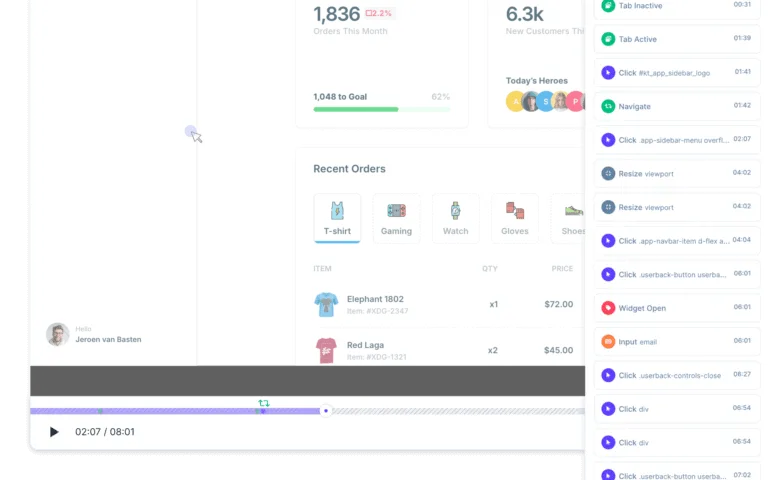
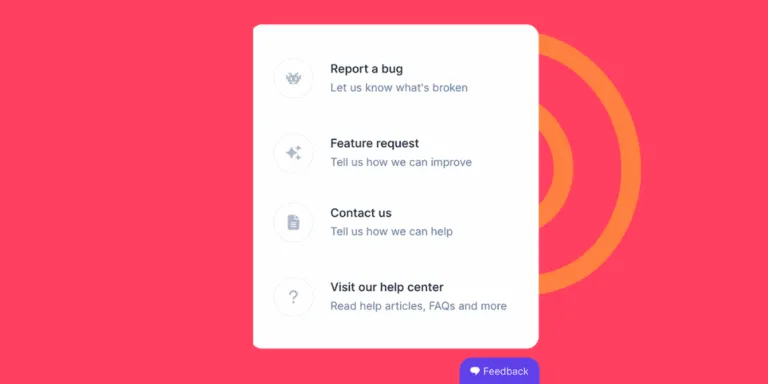
The feedback widget lets any user, free tier included, report a problem or an idea from inside the product in a couple of clicks, with the page, browser and console already attached. Session replay shows what the people who abandoned the onboarding flow actually did. In-product surveys and NPS ask a targeted question at the moment that matters instead of a fortnight later. And a public feature portal turns scattered requests into a ranked demand signal, which is the closest thing PLG has to a pipeline review.
The pattern shows up as speed of diagnosis rather than as a new metric: after centralising feedback this way, Boast cut feedback triage by 75%, and Autymate collected 4× more actionable feedback.
Frequently asked questions
What is an example of product-led growth?
Slack, Figma, Calendly and Dropbox are the standard examples, and they share a structure rather than a category: each one is more useful when a second person is involved, so ordinary use puts the product in front of new users. That is the growth loop doing the work, not the free tier by itself.
What is the difference between product-led and sales-led growth?
In product-led growth the user experiences the product before talking to anyone, and usage qualifies them. In sales-led growth a salesperson qualifies and demonstrates before the product is available. The practical difference is where the first human conversation sits relative to first value.
What are the key metrics used to measure product-led growth?
Time to value, activation rate, free-to-paid conversion, product-qualified leads, net revenue retention and customer acquisition cost. Time to value and net revenue retention carry the most weight: the first gates everything downstream, the second decides whether the economics compound.
What is a product-led growth funnel?
Signup, activation, habit, upgrade, expansion. It differs from a sales funnel in that users move themselves between stages, so each transition is a design problem in the product rather than a task for a person.
Does product-led growth work for B2B?
Yes, and most well-known product-led companies are B2B. What usually changes is the top end: above a certain contract size, procurement and security review require a human, so the common shape is self-serve below a threshold and a sales team above it, triggered by product usage.
Do you need a free plan for product-led growth?
You need value before payment, which a time-limited free trial can also deliver. A free tier suits products with a natural growth loop, where non-paying users expose the product to future customers. A trial suits products with high per-user cost or no viral surface.
Why do product-led growth strategies fail?
Most often for two reasons: time to value is too long, so users never reach the moment that would have convinced them; or the company removed the sales conversation without replacing it as a source of qualitative insight, and is left optimising a funnel it can measure but cannot explain.
Keep listening after the salesperson goes
In-product feedback, surveys and session replay give a product-led team the intelligence channel a sales conversation used to provide.