"I absolutely love Userback! It's been a game-changer for how we collect feedback and interact with our users."

More Customer Stories →

Learn Userback

Customer Feedback Management: The Four Stages, and Who Owns Each One

Capture, categorise, act, close — and the question that decides whether any of it works: who is accountable for the loop.

Customer feedback management: many separate feedback channels converging into one central stream
Contents

Matthew

Customer feedback management is the system a company runs to collect feedback from every channel, categorise it, route it to whoever can act, and report back to the people who raised it. Most companies already gather feedback. What separates a programme that changes decisions from one that produces a quarterly slide is ownership — and it is the difference between collecting customer feedback and being able to act on it.

Key Takeaways

  • Four stages: capture, categorise, act, close the loop
  • Capture direct and indirect channels — a survey-only programme hears from a loud minority
  • Five teams own the inputs and usually nobody owns the outcome; name one owner per stage
  • Measure coverage, time to triage, close rate and repeat feedback — not NPS alone

What is customer feedback management?

Customer feedback management is the process a company runs to collect customer feedback from every channel, categorise and analyse it, route it to whoever can act, and report back to the customers who raised it. It is an operating system rather than a survey programme: the same four stages, running continuously, with someone accountable for each.

The word carrying the weight is management. Almost every company can already gather input; far fewer manage feedback in any deliberate way. Most collect customer feedback already — through support tickets, reviews, NPS surveys and sales calls. What they usually lack is the layer above it: one place the feedback lands, a rule for who decides, and a habit of telling people what happened. That layer is what makes feedback actionable — the difference between having customer feedback and being able to act on feedback at all.

The four stages of customer feedback management

Capture, categorise, act, close. Every framework you will read is a rewording of these four; what separates programmes that work is who owns each stage.

  1. Capture — direct and indirect, from every channel

    Feedback collection splits in two, and a programme needs both halves. Direct feedback is what customers tell you when you ask: survey tools, NPS, interviews, an in-product feedback form. Indirect feedback is what they say without being asked: support tickets, online reviews, social posts, community threads, churn calls. A programme built only on the direct half hears from the people willing to answer a survey, which is a small and unrepresentative slice. Gather feedback from multiple channels continuously, rather than in an annual cycle — and remember that your customer service queue is already the highest-volume feedback channel you own, whether or not anyone is reading it as one.

  2. Categorise — one record per theme, duplicates merged

    Tag each piece of feedback by theme, product area, customer segment and sentiment, and merge duplicates into a single record as they arrive. This is the stage that decides whether analysis is possible at all: when the same request arrives five times through five channels it should read as one theme with five instances, not five small requests. Doing this by hand works up to a few hundred items a month; past that it needs tooling or it silently stops happening.

  3. Act — route it to whoever can actually decide

    To act on customer feedback you first have to route it, because different feedback belongs to different teams. A broken checkout belongs to engineering, a pricing objection to commercial, a confusing onboarding step to product, an unclear help article to customer support. Routing is where most programmes leak: feedback is collected centrally and then sits, because nobody owns the decision. Each theme should end in a named owner and one of four outcomes — fix, build, defer with a reason, or decline with a reason.

  4. Close the loop — tell the customers who raised it

    Go back to the people who reported the issue or asked for the feature and tell them what happened, including when the answer is no. This is the stage almost every programme skips, and it is the one that determines whether you get useful feedback next quarter. Our guide to the customer feedback loop covers the mechanics of this stage in detail.

Where customer feedback comes from, and who usually owns it

ChannelTypeWhat it tells youUsual owner
In-product widgetDirectSpecific problems, in context, at the moment they happenProduct
NPS and CSAT surveysDirectSentiment and how it moves over timeCX or marketing
Customer interviewsDirectThe reasoning behind a behaviourProduct or research
Support ticketsIndirectProblems severe enough for someone to complainSupport
Online reviewsIndirectWhat prospects will read about youMarketing
Social and communityIndirectUnfiltered sentiment, early warningMarketing or community
Churn and win-loss callsIndirectWhat the product cost you commerciallySales or CS
Session recordingsIndirectWhat people did rather than what they say they didProduct

Read the last column downward and the central problem of customer feedback management appears: five different teams own the inputs, and none of them owns the outcome. That is why feedback so often reaches a company without ever reaching a decision.

Who owns customer feedback management?

This is the question most guides on the subject skip, and it decides more than any tooling choice.

The usual arrangement is that support owns the volume — they see the most feedback and are measured on closing tickets, not on themes. Product owns the decisions — but sees only what reaches them, which is whatever support escalated. Marketing owns the reputation — reviews and social, usually in a separate tool. Everyone touches customer feedback and nobody is accountable for the loop, so the loop does not close.

Three arrangements work in practice, and which one fits depends on size rather than sophistication.

Under about thirty people: one named owner, part-time. Usually a product manager. Their job is not to read everything but to run a weekly pass over what arrived, merge duplicates and route themes. Two hours a week, in the calendar.

Thirty to a few hundred: a standing cross-functional review. Support, product and CS in the same monthly meeting, working from one ranked list. The list is prepared in advance; the meeting is for decisions, not for reading.

Larger: a dedicated voice-of-the-customer or insights function. A person or small team whose whole job is the categorise and route stages, feeding product and CX rather than deciding for them.

What does not work is the arrangement most companies actually have: everybody, informally. Feedback that belongs to everyone belongs to nobody, and the tell is simple — ask who decided that the last customer request would not be built, and whether the customer was told.

Write the policy down: one page, five answers

A customer feedback policy sounds like bureaucracy and takes about an hour. It exists so that the answers do not have to be renegotiated every time somebody disagrees, and it is the cheapest thing on this page to implement.

What counts as feedback. Define which inputs enter the process. A support ticket asking how to do something is not feedback; a support ticket saying the thing is impossible to find is. Without this, the backlog fills with noise and people stop trusting it.

Where it goes. One destination, named. If there are two, there are effectively none, because nobody can see the full picture from either.

How fast each stage moves. A target for acknowledgement, one for triage, and one for the reply after a decision. Numbers you would be comfortable telling a customer.

Who decides. By category, by name or by role. This is the line that stops themes ageing in a queue while people wait for someone else to pick them up.

What customers are promised. Whether every submitter hears back, or only those whose item changes status. Either is defensible. Silence is not, and it is what teaches customers to stop bothering.

How customer feedback management fits into customer experience

Customer feedback management is one component of customer experience management, and it is worth being precise about which one, because the terms get used interchangeably by vendors who sell different things.

Voice of the customer is the discipline: the practice of systematically understanding customer needs and customer sentiment. Customer experience management is the wider programme covering every touchpoint on the customer journey, including ones that generate no feedback at all. Customer feedback management is the operational core of both — the machinery that gathers feedback from multiple channels, turns it into something a team can act on, and reports back. Without it, a voice-of-the-customer programme is a set of intentions and a customer experience strategy is a diagram.

The connection to outcomes is more direct than most reporting admits. Feedback helps in two distinct ways. Acting on customer feedback removes the friction that drives churn, so customer retention improves for reasons you can point at. And closing the feedback loop improves customer satisfaction independently of the fix, because being told your input mattered changes how the whole relationship reads. Repeat feedback then rises, which improves the input quality for the next cycle. That compounding is the argument for treating feedback management as infrastructure rather than as a survey line item.

Where it does not help: customer feedback cannot tell you what customers have never experienced. It is excellent at improving what exists and poor at inventing what does not. Teams that run entirely on customer input build very polished versions of what they already have, which is why customer feedback management belongs alongside research and strategy rather than replacing them.

Feedback analysis: turning feedback data into themes

The categorise stage is where most of the work lives, and where most programmes quietly break. Feedback collection is easy to start and feedback analysis is what makes it worth anything.

Separate the type of feedback from the theme. A single support ticket can be a bug report, a feature request and a complaint about tone all at once. Tagging type and theme as separate dimensions means you can later ask both “how much negative feedback did onboarding generate” and “how many customers asked for exports”, which one combined label cannot answer.

Weigh by customer, not by comment. Twenty comments from three customers is a smaller signal than eight comments from eight. Counting instances rather than distinct accounts is the most common way feedback data misleads a roadmap.

Keep the qualitative feedback attached. A theme with a count is a number; a theme with three verbatim quotes underneath it is an argument. When the analysis is presented to people who did not read the raw input, the quotes are what carry it.

Let AI do the first pass, not the last. Modern feedback management tools will cluster and tag automatically, which turns hours into minutes on volume no human would read. What they are not reliable at is judging severity or spotting the important thing said once. Use them to sort, then read the top of each pile yourself.

The output of good feedback analysis is not a report. It is a ranked list of themes, each with a count of distinct customers, a segment breakdown, a few quotes, and a named owner — which is exactly what the act stage needs to start from.

What to look for in a customer feedback management system

CapabilityWhat good looks likeWhy it matters
Capture without frictionFeedback submitted in-product in seconds, no login, no forms to hunt forVolume drops off a cliff with every extra click, and the people you lose are the quiet majority
Context attached automaticallyURL, browser, OS, console, session recording captured with the reportRemoves the round trip that turns a two-minute fix into a two-week ticket
One inbox with real deduplicationMerge duplicates into a single record that keeps every instanceThis is what makes frequency a number rather than a feeling
Routing and integrationsPush to the tools each team already lives in, and sync status backFeedback that requires a second tool to action gets actioned late or never
Closing the loop built inNotify the requester automatically on status changeThe stage most likely to be dropped is the one that most needs to be automatic
Reporting you would show a boardThemes by volume, by segment, by revenue at riskTurns the programme from a cost into an argument

You do not need all six on day one, and a customer feedback management tool is not the first thing to buy — the process has to exist before a platform can carry it. Capture and one inbox are the two that make the rest possible — a programme with excellent reporting over incomplete, un-deduplicated input is reporting confidently on noise.

Collected, or managed? The same company, two years apart

Collected

Feedback everywhere, decisions nowhere

Where it lives
Helpdesk, a survey tool, two Slack channels, a spreadsheet
Owner
Everyone, informally
Prioritised by
Whoever escalated most recently
Customer hears back
If someone remembers
Reported as
A quarterly NPS number with no explanation

Response rates fall every cycle, and nobody can say which theme cost the most revenue.

Managed

One pipeline, named owners, answers go back

Where it lives
One inbox, duplicates merged, every channel feeding it
Owner
Named per stage, written in the policy
Prioritised by
Frequency, segment, and revenue at risk
Customer hears back
Automatically, on status change, declines included
Reported as
Ranked themes with volume and value attached

The same inputs. The difference is entirely in the layer above them.

How to measure a customer feedback programme

Most programmes report the wrong number. Satisfaction scores measure the product and the market as much as the programme, so a rising NPS or customer satisfaction score says little about whether feedback management is working. They tell you the weather, not whether the process ran.

Four measures that track feedback across the whole pipeline say more.

Coverage. What share of active customers gave you any feedback this quarter? A programme hearing from two per cent is describing a very loud minority.

Time to triage. How long from arrival to categorised and routed. When this rises, the categorise stage has quietly stopped happening.

Close rate. What share of raised items ended in a reply to the person who raised them. This is the honest health metric, and it is usually the ugliest.

Repeat feedback rate. How many customers give feedback a second time. It is the only measure that tells you whether closing the loop is working, because people who hear back come back.

Satisfaction scores still belong in the report as outcomes rather than as the scoreboard. Which product metrics to pair them with is covered in the product management KPIs guide.

Six ways companies get customer feedback management wrong

These are the failure patterns that come up again and again, and none of them is solved by buying a feedback management platform.

Asking more instead of listening better. The reflex when a programme feels thin is to send another survey. The higher-yield move is usually to read the feedback channels you already have — support tickets and reviews are sitting there, unanalysed, in most companies.

Measuring the score and not the process. A team that tracks only NPS or customer effort score sees whether sentiment moved and never why. Track feedback throughput alongside it: how much arrived, how fast it was triaged, how much got an answer.

Treating all feedback as equally valid. A request from a churning enterprise account and one from a trial user who never activated are not the same signal. Weighting by segment is what makes feedback helpful to a commercial conversation rather than just a product one.

Confusing what customers ask for with what they need. Customers describe solutions; the useful part is the problem underneath. “Add a bulk export button” and “I spend two hours a month copying data out” lead to different roadmaps, and only the second one is the actual requirement.

Letting the loop close silently. Shipping the fix and not telling anyone is the most common way to waste work already paid for. The act of replying is what converts a fix into customer loyalty, and it costs a sentence.

Buying a tool to fix a process problem. A tool like a feedback platform makes an existing process faster; it does not create one. If nobody owns triage today, nobody will own it in the new system either — the backlog will simply be better organised while it ages.

The through-line: what makes feedback useful is decisions and accountability, and only partly software. Effective customer feedback management is mostly an operating habit, and the habit is what improves customer experience over time. Companies that manage customer feedback well tend to have a boring, documented process and one person who cares whether it ran this week.


Running the four stages without the admin

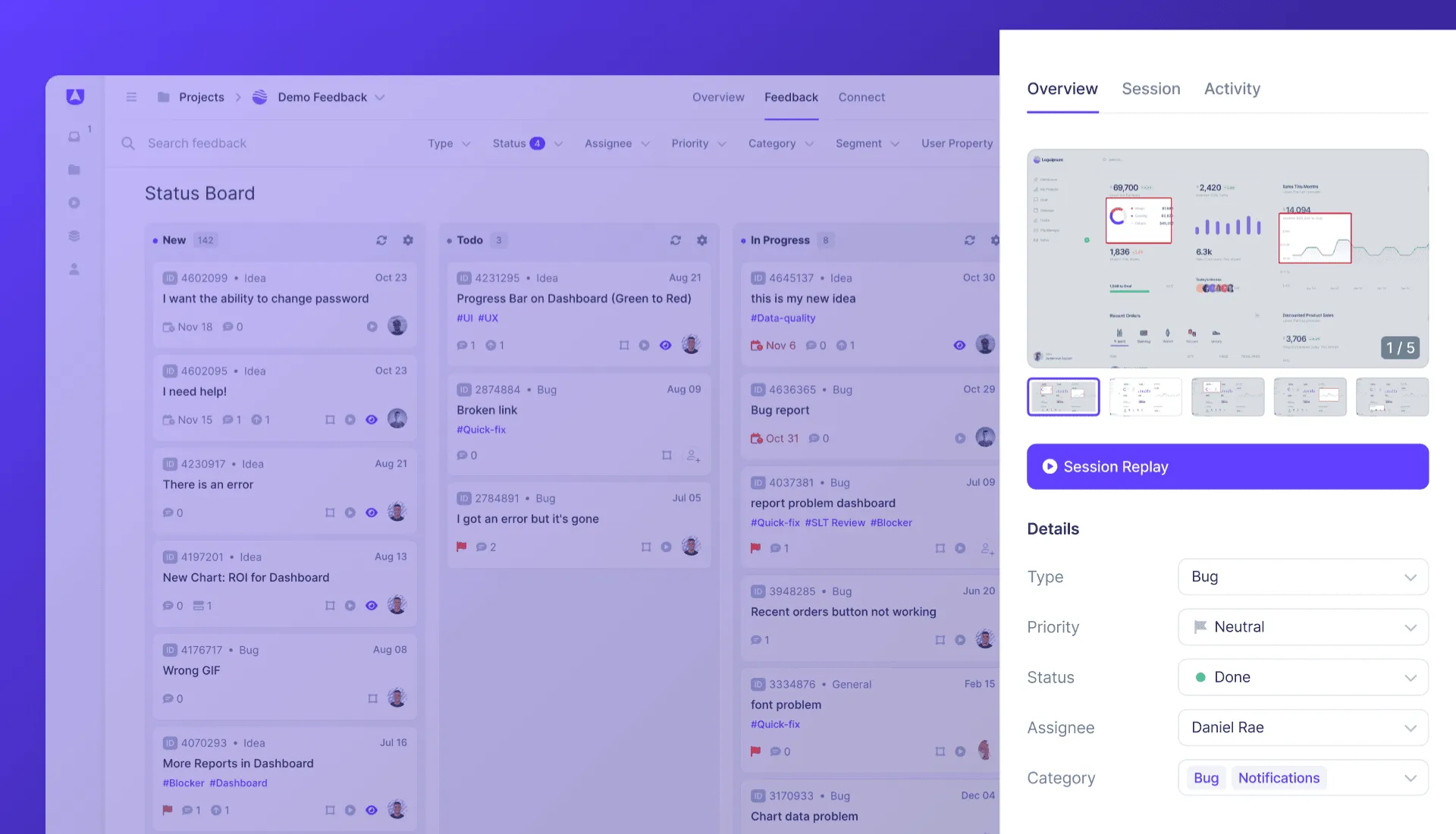
Feedback Status Board

Every stage above can be run with a shared inbox, a spreadsheet and discipline. Programmes fail because the discipline has to hold every week for years, and it does not.

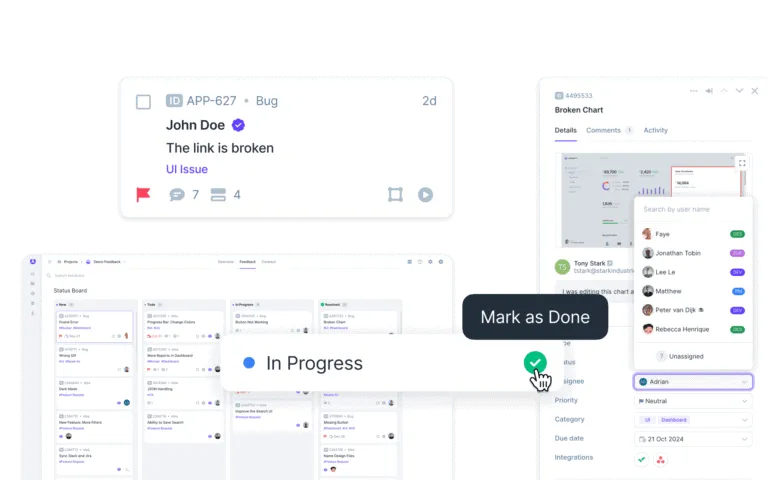
Userback removes the manual steps rather than asking people to try harder at them. Feedback arrives through an in-product widget with the page, browser, console and a session recording already attached, so the capture stage does not depend on the customer knowing technical details. It lands in one inbox where duplicates merge into a single record, which is the categorise stage. Integrations push items into the tools each team already works in and sync status back, which is routing. And when an item changes status, everyone who raised it is notified — the close stage, automatic rather than remembered.

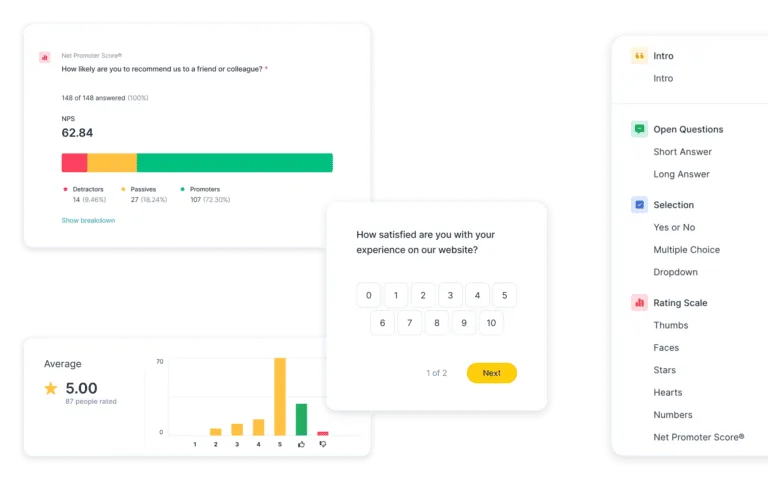
A public feature portal adds the demand signal that makes prioritisation defensible, and surveys and NPS cover the direct channels alongside it. After centralising feedback this way, Boast cut feedback triage by 75%, and Autymate collected 4× more actionable feedback.

Frequently asked questions

What is the customer feedback management process?

Four stages: capture feedback from direct and indirect channels, categorise it into themes with duplicates merged, act by routing each theme to a named owner who decides, and close the loop by telling the customers who raised it what happened.

What is a customer feedback management system?

Software that runs those four stages in one place: it captures feedback from your channels, deduplicates and tags it, routes items into the tools your teams already use, and notifies the original requester when something changes. The alternative is a shared inbox and a spreadsheet, which works until volume outgrows the discipline.

What is the difference between customer feedback management and a feedback loop?

The loop is the cycle a single piece of feedback travels. Management is the system that makes the loop run reliably across every channel and team — ownership, policy, routing and reporting. One is the mechanism, the other is the operating model around it.

Who should own customer feedback management?

One named person or function, not a committee. Under about thirty people that is usually a product manager spending two hours a week; in mid-size companies a standing cross-functional review; at scale a dedicated voice-of-the-customer function. The failure mode is shared ownership, which in practice means none.

What is the difference between direct and indirect feedback?

Direct feedback is what customers say when you ask — surveys, NPS, interviews, an in-product widget. Indirect feedback is what they say without being asked — support tickets, reviews, social posts, churn calls. A programme built on only one of the two is systematically biased.

How do you measure customer feedback management?

Coverage, time to triage, close rate and repeat feedback rate. Satisfaction scores such as NPS and CSAT are outcomes influenced by the whole business, so they belong in the report but not as the scoreboard for the programme itself.

Do small companies need customer feedback management?

They need the process, not the platform. A shared inbox, a weekly triage pass and a habit of replying will carry a small team a long way. Tooling earns its place when deduplication becomes manual work or when closing the loop stops happening because nobody has time.

One place for feedback, from every channel

Capture, deduplicate, route and close the loop — automatically, so the process runs without anyone having to remember it.