"I absolutely love Userback! It's been a game-changer for how we collect feedback and interact with our users."

More Customer Stories →

Learn Userback

How to Create a Product Roadmap: Six Steps, and the Input Layer Everyone Skips

Vision, inputs, themes, prioritisation, horizons, review — and why step two decides whether the other five are worth anything.

How to create a product roadmap: a road receding toward the horizon through three milestone gates
Contents

Matthew

A product roadmap is a shared plan showing what a product team intends to achieve and why, at theme level rather than as a dated feature list. Building one takes six steps, and it should align the development team, leadership and customers around the same product strategy. The step that decides the quality of everything downstream is the second: what you collect, and whether you can count it.

Key Takeaways

  • A roadmap is a communication tool, not a delivery schedule
  • Work at theme level so the plan survives the answer changing
  • Precision should decay with distance: firm now, rough later
  • Prioritisation is only as good as the input; scattered feedback makes one big theme look like four small ones

What is a product roadmap?

A product roadmap is a shared plan that shows what a product team intends to achieve, in what order, and why. It communicates direction and priorities to the people who need them, rather than committing the development team to a fixed list of features on fixed dates.

The word that causes the most trouble here is plan. A product roadmap is a communication tool first: its job is to let an executive, a developer and a customer each look at one artefact and align on what the product is trying to become. A product plan or delivery schedule can be derived from it, but a roadmap that is only a delivery schedule stops being useful the first time a date moves.

How to create a product roadmap in six steps

Vision, inputs, themes, prioritisation, timeframes, review. This is how to build a product roadmap in order, and the order matters: every step narrows what the next one is allowed to consider.

  1. Start from the product vision and the goals under it

    Write the product vision as one or two plain sentences describing where the product is going and for whom, then set the goals for the product underneath it. Those goals are what the roadmap has to align to, and without them every prioritisation argument becomes a matter of taste because there is no shared definition of better. A product strategy answers how we intend to win; the roadmap answers what we are doing about it next. This is also where you decide who each version of the roadmap is for.

  2. Collect the inputs, from everywhere, in one place

    Pull feature requests, customer feedback, support themes, sales and churn conversations, user research and market signals into a single backlog. The critical word is single: input scattered across a helpdesk, a spreadsheet and three Slack channels cannot be weighed, because nobody can see how often the same thing was asked. Every guide lists this step; the section below covers the part they leave out.

  3. Turn requests into themes

    Group what arrived into a small number of themes or outcomes rather than a list of features. “Reduce time to first value” is a theme; “add a setup wizard” is one possible answer to it. Working at theme level is what keeps the roadmap honest when the answer changes, and it is the difference between a product roadmap and a feature list with quarters printed on it.

  4. Prioritise with a framework, then apply judgement

    Score the themes with something explicit — impact versus effort, RICE, or a weighted model of your own. The framework’s real value is not the number it produces but the argument it forces into the open. Then override it deliberately where you have information the model does not, and write down why. That note is what you will need in three months when someone asks how this got to the top.

  5. Map it to timeframes and dependencies

    Place the themes on horizons rather than calendar dates: now, next, later, or by quarter. Mark what depends on what, because a dependency discovered late is the most common reason a roadmap slips. Give near-term items more precision than distant ones — certainty that decays with distance is honest, and a roadmap that claims equal confidence about next month and next year will not be believed twice.

  6. Share it, then keep it alive

    Publish the version each audience needs and put a review cadence in the calendar — monthly for most teams, per sprint for fast ones. A roadmap that is not revisited becomes a historical document that people quietly stop consulting. Reviewing means moving things and saying so, including removing items you have decided not to build.

Types of product roadmap, and who each one is for

TypeAudienceWhat it showsTime horizon
Strategy roadmapLeadership, the board, the VP of productThemes and business outcomes tied to company goalsQuarters or halves
Product development roadmapThe development team and product ownersEpics, dependencies, release trainsSprints or months
Public or customer roadmapCustomers and prospectsCommitted, in progress, recently shippedDeliberately vague
Portfolio roadmapSeveral product teams at onceHow products relate and where they overlapQuarters
Now-next-later roadmapAny audience, early-stage productsOrdered themes with no dates at allNone
Feature roadmapProduct marketing and salesNamed capabilities against release windowsMonths

Whichever type of roadmap a product manager reaches for, these are views of one set of decisions rather than six different plans. The failure mode is maintaining them separately until they disagree — at which point the development team and the customer are being told different things about the same product. A product roadmap template is worth having for the presentation, but it will not resolve that; only a single underlying set of themes will.

Where the input for a roadmap actually comes from

Every guide to building a product roadmap includes a step that reads roughly “gather customer feedback and market research”, and then moves on to prioritisation. That gap is where most roadmaps go wrong, because the prioritisation is only as good as what went into it.

Two problems live in that gap. The first is coverage. Feedback that arrives unprompted comes from the loudest tenth of your users — the enthusiasts and the very annoyed. Building a roadmap from it means building for people unlike your median customer. The fix is at least one passive channel, such as usage data or session recordings, alongside the active ones.

The second is counting. When the same request arrives four times through four channels, it looks like four small requests rather than one significant theme. Teams then prioritise by whoever asked most recently or most insistently, which feels like judgement but is really an artefact of scattered data. This is why the collection step says one place, duplicates merged: without it, the framework in step four is scoring noise with impressive precision.

A practical test: pick the top item on your current roadmap and ask how many distinct customers asked for it, and how you know. If the answer is a name rather than a number, the input layer is the thing to fix before the roadmap is. Our guide to the customer feedback loop covers that pipeline end to end.

Feature list or roadmap? The same quarter, two ways

Feature list

A backlog with quarters printed on it

Q1 row
SSO, dark mode, CSV export, new dashboard
Rationale
Not stated
Success
All four shipped
If priorities change
The roadmap is now wrong and quietly ignored

Every conversation about it becomes a negotiation over whether an item stays on the list.

Outcome roadmap

Themes, with features as the current best answer

Q1 theme
Make the product safe for enterprise buyers
Rationale
Named in 9 of 14 lost-deal calls last quarter
Success
Security review stops blocking deals
If priorities change
The answer changes, the theme and the reason still hold

SSO may still be the first thing built. The difference is that everyone knows what it is for.

Prioritisation frameworks worth knowing

FrameworkBest forHow it worksWhere it breaks
Impact vs effortA quick first pass on a mixed backlogTwo axes, plot everything, take the top-leftEffort estimates are guesses early on
RICEComparing initiatives of similar sizeReach, impact, confidence, effort as one scoreConfidence is the field people fudge
MoSCoWScoping one release with stakeholdersMust, should, could, will not haveEverything becomes a Must without a cap
KanoDeciding what actually delightsSorts features into basic, performance, delightNeeds real customer research to run
Weighted scoringMature teams with agreed criteriaYour own criteria, weighted and summedOnly as good as the weights you argued over

None of these decides anything for you. They make the reasoning visible, which is what lets a team disagree productively instead of deferring to whoever spoke last.

What separates the best product roadmaps

Plenty of teams build a roadmap that looks right and changes nothing. The difference between an excellent roadmap and a decorative one comes down to four things, and none of them is the tool it was drawn in.

It states business outcomes, not activity. The best roadmaps say what will be different for the customer and the company if this works. A roadmap that lists what the product development process will be busy with tells a reader nothing about whether it is worth doing.

It carries its reasoning. Each theme has a sentence saying why it is there and what evidence put it there. This is what makes a roadmap survive a change of product manager, and what turns a review into a decision rather than a debate about memory.

It is honest about confidence. An agile roadmap that is firm about this month and deliberately vague about next year is more useful than one that projects false precision across a year. Readers calibrate on the parts they can check.

Everyone who needs it has access to the roadmap. A plan that lives in one person’s slide deck is not a communication tool. When the roadmap changes, the change should reach the development team, leadership and — for anything you committed to publicly — the customer, without anyone having to ask. That is what keeps the organisation aligned between reviews rather than only during them.

None of this requires a new product management suite. It requires that the roadmap reflects real evidence and that the evidence is reachable, which is why the input layer keeps coming back as the thing that decides whether a successful product roadmap is possible at all.

Keeping the roadmap current after the first draft

Nearly every guide ends with “treat it as a living document” and stops there. In practice, three habits are what keep a product roadmap alive.

Put the review in the calendar, with an owner. A standing monthly session where themes are re-ranked against what has been learned. Not a status meeting — a decision meeting, where things are allowed to move down.

Record why something changed, not just that it did. The reason is the part that has value later. A roadmap whose history reads “moved to Later” teaches nobody anything; one that reads “moved to Later — the two accounts driving it both renewed without it” is an argument you can reuse.

Close the loop with whoever asked. When a theme ships, tell the customers whose requests fed it. When it is declined, say so and why. This is the step that decides whether you get useful input for the next roadmap: people who never hear back stop bothering, and the input layer quietly degrades until you are building for the loudest tenth again.


Making the input layer trustworthy

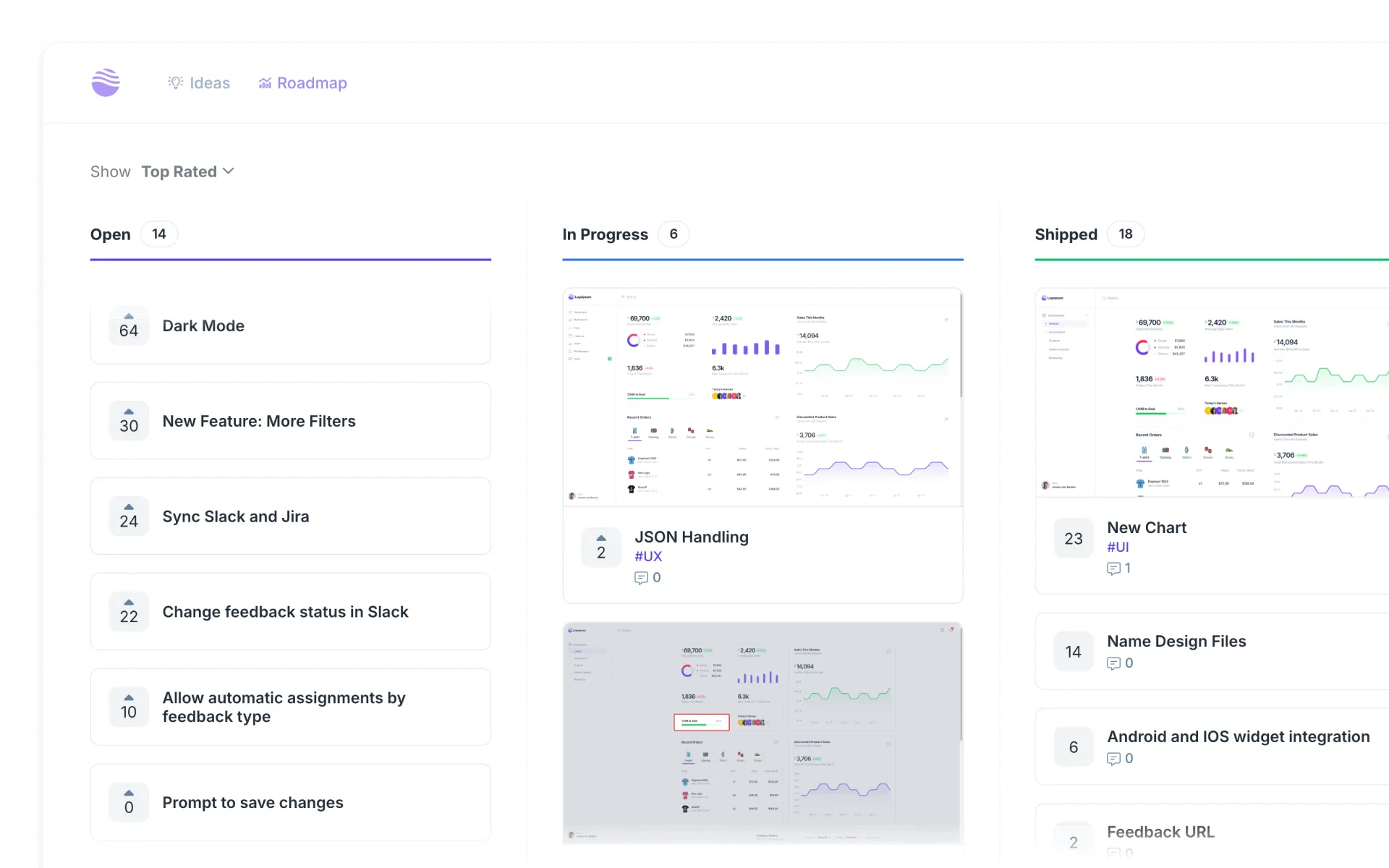
Userback roadmap

The mechanics of a roadmap — themes, horizons, a prioritisation model — can be run in a spreadsheet. What a spreadsheet cannot do is make the input reliable, and that is the layer this guide keeps returning to.

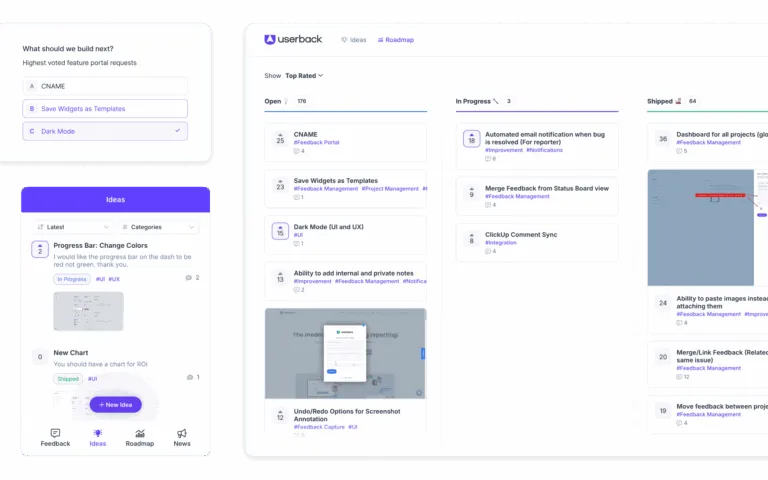
Userback covers the collection step: feedback and feature requests arrive from inside the product, land in one place, and merge into a single record per theme, so frequency is a number you can read rather than a feeling. A public feature portal adds demand signal by letting customers vote on what already exists instead of filing the fifth duplicate, and surveys and session replay supply the passive channel that stops the roadmap being written by its loudest users.

The last step is the one that keeps the next round honest: when a theme ships or is declined, everyone who asked for it is notified. After centralising feedback this way, Boast cut feedback triage by 75%, and Autymate collected 4× more actionable feedback.

Frequently asked questions

How do I create my own product roadmap?

Write the product vision and the goals under it, collect every input into one backlog, group requests into themes rather than features, prioritise the themes with an explicit framework, place them on horizons with dependencies marked, then review on a fixed cadence and tell people what changed.

What should a product roadmap include?

At minimum: the product vision, a small set of themes or outcomes, the reason each one is on the list, a rough time horizon, and known dependencies. What it should not include is a precise date for every item — that is a delivery plan, and it belongs in a different document.

What is the difference between a product roadmap and a backlog?

A roadmap says what you intend to achieve and why, at theme level. A backlog says what you will build next, at ticket level. The roadmap should be readable by someone outside the development team; the backlog usually should not be.

Should a product roadmap have dates?

Use horizons rather than dates for anything beyond the next quarter. Precision should decay with distance: firm for what is in progress, a quarter for what is next, a rough ordering for what is later. Committing to distant dates you cannot keep is what teaches people to stop trusting the roadmap.

How often should a product roadmap be updated?

Review monthly for most teams, or every sprint for fast-moving ones. The review matters more than the frequency: it has to be a session where items can genuinely move down or come off, otherwise it is a status report.

Can you give an example of a product roadmap theme?

“Make the product safe for enterprise buyers”, evidenced by security requirements coming up in nine of fourteen lost-deal calls, and measured by whether security review stops blocking deals. SSO might be the first thing built under it, but the theme survives even if the answer turns out to be something else.

What is the best software for product roadmapping?

Roadmap tools handle the presentation layer, and most teams find that the harder problem is the input layer feeding it. Whatever you use to draw the roadmap, the thing worth investing in first is a reliable way to collect, deduplicate and count what customers are actually asking for.

Build the roadmap on evidence, not the loudest voice

Userback centralises feature requests and merges duplicates, so how often something was asked becomes a number you can read.